

By Jason Boice, REALTOR®, eXp Realty — Published on September 18, 2026
One of the most common questions I get from both buyers and sellers is:
Who actually pays the closing costs?
The answer isn't as simple as saying buyers pay one set of expenses and sellers pay another.
Some expenses traditionally fall on one side of a Connecticut real estate transaction. Others depend on the buyer's financing. And some—including seller credits and buyer-agent compensation—can be negotiated as part of the offer.
There's another reason this gets confusing.
A buyer's closing costs aren't the same thing as their cash needed to close.
And a seller's closing costs aren't the same thing as the amount deducted from their proceeds at closing.
For example, a buyer's down payment can represent a huge portion of their cash needed to close, but it isn't technically a closing cost.
Similarly, paying off a seller's existing mortgage can consume a large portion of their proceeds, but the mortgage principal isn't really a cost of selling the property. It's repayment of an existing debt.
Understanding those distinctions makes it much easier to figure out how much money you'll actually need—or walk away with—at closing.
TL;DR: Who Pays What at a Connecticut Home Closing?
Here's the simplified version:
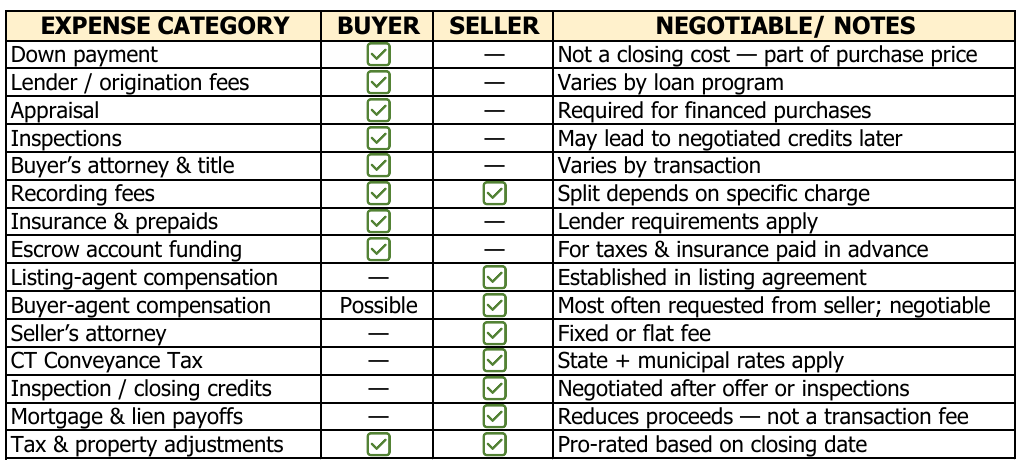
*An existing mortgage or lien affects the seller's net proceeds, but repaying principal isn't the same thing as a transaction fee.
The biggest takeaway is:
Don't evaluate a Connecticut real estate transaction based solely on the purchase price. What each party actually pays—and what the seller ultimately nets—depends on the entire structure of the deal.
What Closing Costs Does a Buyer Pay in Connecticut?
Buyers typically have several expenses in addition to their down payment.
The exact amount depends heavily on the property, mortgage program, lender, inspections performed, insurance, taxes, attorney/title costs, and negotiated terms of the offer.
Let's break down the major categories.
1. Mortgage and Lender Costs
If you're financing the purchase, your lender will typically have costs associated with obtaining the mortgage.
Depending on the loan, these could include things such as:
Loan origination or lender fees
Credit-related charges
Underwriting or processing-related costs
Discount points, if applicable
Other loan-specific charges
This is one reason I don't like giving buyers a generic statement like:
"Closing costs are always X% of the purchase price."
Two buyers purchasing identical $500,000 houses could have very different closing costs because they're using completely different financing.
Your lender should provide a Loan Estimate detailing the anticipated costs associated with your mortgage.
2. The Appraisal
Most financed purchases require an appraisal.
The lender uses the appraisal as part of determining whether the property provides sufficient collateral for the mortgage.
The buyer generally pays for this.
An appraisal is also different from a home inspection.
The appraiser is determining value for the lender.
The appraiser isn't performing the buyer's home inspection.
3. Home Inspections
Buyers also generally pay for whatever inspections they choose to perform.
Depending on the property and the terms of the purchase, that could include:
General home inspection
Septic inspection
Well-water testing
Radon testing
Pest/wood-destroying insect inspection
Chimney inspection
Sewer-related inspection
Other specialty inspections
Not every buyer performs every inspection.
The property itself often determines which inspections are relevant.
And inspections can ultimately affect the seller's costs too, which I'll explain later.
4. Buyer's Attorney and Title-Related Expenses
Connecticut buyers typically work with an attorney during the transaction.
There can also be expenses associated with the title work and closing process.
The exact charges can vary depending on the transaction, attorney, lender, and property.
This is another area where the buyer should review the specific numbers provided by their attorney and lender rather than relying on a generic online calculator.
5. Recording Fees
Certain documents related to the purchase and financing need to be recorded in the land records.
The buyer may therefore see recording-related charges as part of the closing.
Again, these are usually relatively small compared with the down payment, but they're part of the total cash calculation.
6. Homeowners Insurance
If you're financing the purchase, your lender will generally require homeowners insurance.
Depending on the transaction and lender requirements, the buyer may need to pay insurance-related amounts before or at closing.
That contributes to the difference between the purchase price and the actual cash needed to close.
7. Prepaid Expenses and Escrows
This is another category that sometimes surprises buyers.
You may need to prepay certain expenses or establish escrow reserves for things such as:
Property taxes
Homeowners insurance
Other lender-required reserves
This money isn't necessarily a "fee" in the same sense as paying an attorney or appraiser.
Some of it is money being collected now to pay expenses that will become due later.
But it's still money the buyer may need available for closing.
Closing Costs vs. Down Payment: They're Not the Same Thing
This is one of the most important distinctions for first-time buyers.
Suppose you're buying a $400,000 house and putting 10% down.
Your down payment is:
$40,000
But that doesn't mean you only need $40,000.
You'll also have closing expenses, prepaid items, and potentially escrow funding.
There may also be credits, deposits already paid, or other adjustments affecting the final number.
That's why I tell buyers to focus on:
Cash to close.
That's the amount that ultimately matters when planning how much money you need to complete the purchase.
Your lender and attorney will provide the final numbers as you approach closing.
Does the Buyer Pay Their Real Estate Agent in Connecticut?
This is an area where consumers encounter a lot of outdated or oversimplified information online.
Buyer-agent compensation is negotiable.
A buyer and their agent should have an agreement establishing the agent's compensation.
When the buyer submits an offer on a property, the offer can request that the seller pay some or all of the buyer-agent compensation as part of the transaction.
In my Connecticut transactions, 2.5% is the most common buyer-agent compensation amount I see requested.
But 2.5% is not a required Connecticut rate.
It can be negotiated.
A seller might accept the request.
A seller might counter it.
For example, I've seen sellers counter a 2.5% request at 2%.
Or the buyer could potentially be responsible for some or all of their agent's compensation depending on their buyer representation agreement and what is negotiated with the seller.
Why Buyer-Agent Compensation Matters to the Seller's Net
This becomes particularly important when a seller is comparing multiple offers.
Imagine two buyers both offer:
$500,000
Buyer A asks the seller to pay 2.5% toward buyer-agent compensation.
Buyer B is paying their agent directly and doesn't make the same request.
Those aren't financially identical $500,000 offers from the seller's perspective.
All else being equal, Buyer B produces a higher net.
It's relatively rare in my transactions for buyers to pay their agent entirely themselves when seller-paid buyer-agent compensation is available.
But I have seen buyers use it strategically in competitive multiple-offer situations.
By taking that expense off the seller's side of the transaction, the buyer can make their offer financially stronger without necessarily increasing the headline purchase price.
This is why I tell sellers:
Don't just look at the offer price. Look at what you actually net.
What Closing Costs Does a Connecticut Seller Pay?
The seller side looks different.
The major items I generally discuss with sellers include:
Listing-agent compensation
Negotiated buyer-agent compensation
Attorney fees
Connecticut conveyance tax
Negotiated buyer credits or concessions
Adjustments/prorations
Other transaction-specific charges
And then we need to account for:
Existing mortgage payoff
Home equity loans or lines of credit
Other liens that must be satisfied
Those last items aren't necessarily costs of selling the house, but they're extremely important when calculating how much money the seller will actually receive.
1. Listing-Agent Compensation
The listing brokerage's compensation is typically paid from the seller's proceeds at closing.
Real estate brokerage compensation is negotiable.
This should be clearly established in the listing agreement before the property is marketed.
2. Buyer-Agent Compensation
As discussed above, the buyer's offer may request that the seller pay toward the buyer's agent compensation.
In the transactions I'm seeing in Connecticut, 2.5% is the most common request.
But again:
It's negotiable.
Some sellers agree to the full request.
Some counter at a lower amount, such as 2%.
And occasionally, particularly in a highly competitive multiple-offer situation, a buyer may choose to pay their agent directly to improve the seller's net.
When I'm helping a seller evaluate offers, I want to account for this just like any other financial term.
3. Connecticut Conveyance Tax
Connecticut sellers generally have conveyance tax due when transferring real estate.
This is one of the more significant seller-specific closing expenses and should be included when estimating net proceeds.
The exact amount depends on the transaction and applicable state and municipal rates.
Because tax rules and rates can change and particular transactions can have different treatment, I recommend confirming the exact conveyance-tax calculation with the closing attorney rather than relying on an online estimate.
4. Seller's Attorney Fees
The seller will typically have an attorney representing them through the transaction and closing.
The attorney can assist with the contract, title/closing issues, payoff information, documents, and other legal aspects of the sale.
The attorney's fee should therefore be accounted for when estimating the seller's net.
5. Seller Credits and Concessions
This is where closing costs can change after the original offer is accepted.
A buyer might request a seller credit in the initial offer.
Or one might be negotiated later because of an inspection issue.
Instead of the seller physically repairing something, the parties might agree that the seller will provide a credit at closing, subject to any applicable lending and contract requirements.
That reduces the seller's proceeds but may be preferable to completing the work.
Real Connecticut Example: $5,000 Credit at 559 East Street in Hebron
I recently helped sell 559 East Street in Hebron, and we had a good example of how this works.
After inspections, the buyer requested that the sellers address certain repairs.
Rather than having the sellers coordinate and complete the repairs before closing, we negotiated a different solution:
The sellers agreed to provide the buyer with a $5,000 closing-cost credit.
For the sellers, there were advantages to that approach.
They didn't have to find contractors, schedule the work, manage repairs, and then potentially have additional conversations about whether everything was completed to the buyer's satisfaction.
Instead, the transaction could continue toward closing and the negotiated $5,000 reduced the sellers' final proceeds.
For the buyer, the credit helped with eligible closing expenses, subject to the transaction and lender requirements.
It's a good example of why the costs shown when a seller initially accepts an offer aren't necessarily the final costs.
Inspections and negotiations can change the seller's net.
Why Sellers Sometimes Prefer a Credit Instead of Making Repairs
I've been involved in plenty of transactions where a credit is simply cleaner.
Suppose an inspection identifies an issue.
There are generally several possible outcomes depending on the contract:
The seller might make the repair.
The seller might provide a credit.
The parties might renegotiate another financial term.
The buyer might accept the condition without a concession.
Or the issue could affect whether the transaction proceeds at all, depending on the contract and contingencies.
There isn't one universally correct solution.
But from a seller's perspective, a credit can sometimes eliminate the logistical headache of completing work before closing.
6. Existing Mortgage and Liens
This is where seller "closing costs" can get confusing.
Suppose you sell your house for:
$500,000
and owe:
$250,000 on your mortgage.
That $250,000 generally needs to be satisfied as part of the closing.
But I wouldn't describe the entire $250,000 as a $250,000 selling expense.
You're repaying money you previously borrowed.
The same concept applies to other liens that need to be satisfied.
What matters to the seller is that these obligations reduce the amount of money available to them after the transaction.
That's why I prepare seller estimates based on net proceeds, not simply closing fees.
Selling Price Is Not the Same as Net Proceeds
This is one of the most important concepts for sellers.
Imagine two houses both sell for $500,000.
Seller A owes $100,000 on their mortgage.
Seller B owes $350,000.
Their sale prices are identical.
Their checks at closing obviously won't be.
And even two sellers with identical mortgage balances can have different proceeds because their transactions include different:
Brokerage compensation
Buyer-agent compensation
Credits
Conveyance taxes
Attorney expenses
Adjustments
Liens
Other transaction costs
So when a seller asks me:
"If my house sells for $500,000, how much will I walk away with?"
The $500,000 alone isn't enough information.
We need to build a seller net sheet.
Buyer Cash to Close vs. Seller Net Proceeds
Here's the simplest way to think about the two sides.
BUYER
Purchase Price
minus financing
plus closing expenses
plus prepaids/escrows
plus any buyer-agent compensation owed directly
minus deposits already made
minus applicable seller credits
= Approximate Cash to Close
SELLER
Sale Price
minus mortgage/liens
minus listing-agent compensation
minus negotiated buyer-agent compensation
minus conveyance tax
minus attorney/transaction expenses
minus negotiated credits
plus/minus applicable adjustments
= Approximate Net Proceeds
Those calculations can become more complicated depending on the transaction, but that's the basic framework.
Can a Buyer Ask the Seller to Pay Closing Costs in Connecticut?
Yes.
A buyer can potentially structure an offer requesting a seller credit toward allowable closing costs.
Whether the seller should agree is a completely different question.
It depends on:
Purchase price
Seller's expected net
Other offer terms
Competition
Property value
Appraisal considerations
Financing requirements
The seller's priorities
A seller might be perfectly willing to provide a credit if the overall economics of the offer are strong enough.
That's why I don't evaluate concessions in isolation.
Example: A Higher Offer With a Credit
Imagine a seller receives:
Offer A: $500,000 with no closing-cost credit.
Offer B: $510,000 with a $10,000 seller credit.
At the most basic level, those offers could produce a similar gross result before considering other terms and costs.
But then we still need to evaluate:
Financing.
Appraisal risk.
Inspection terms.
Buyer-agent compensation.
Closing date.
Contingencies.
Probability of closing.
That's why comparing offers isn't simply:
Which number at the top is highest?
Who Pays for Repairs After a Connecticut Home Inspection?
There's no automatic rule that says:
The seller pays for everything the inspector finds.
Inspection rights and obligations depend on the purchase contract.
A buyer may request repairs or financial concessions.
The seller may agree, refuse, or negotiate depending on the contractual situation.
The $5,000 credit at 559 East Street is one example of a negotiated solution.
The buyer requested repairs.
Instead of completing those repairs, the sellers agreed to the credit.
That's negotiation—not a predetermined closing cost.
What Costs Are Actually Negotiable?
A surprising amount of the financial structure of a real estate transaction can be negotiated.
Depending on the circumstances, that may include:
Purchase price
Seller closing-cost credits
Buyer-agent compensation requested from the seller
Inspection-related credits
Certain repair obligations
Other concessions
Other costs aren't really negotiable between buyer and seller because they're charged by a lender, attorney, municipality, insurer, inspector, or another provider.
That's why it's helpful to distinguish between:
transaction expenses
and
offer terms.
How Much Should a Connecticut Buyer Budget for Closing?
I would be cautious about relying on a single percentage.
The buyer's actual costs depend too much on:
Purchase price
Loan program
Down payment
Interest-rate/point structure
Taxes
Insurance
Escrow requirements
Attorney/title costs
Inspections
Buyer-agent compensation arrangements
Negotiated seller credits
A buyer using one mortgage program may need a substantially different amount than another buyer purchasing the exact same house.
Your lender and attorney are the best sources for the final cash-to-close calculation.
Before submitting offers, however, I want my buyers to understand the likely expenses so we aren't discovering a cash problem days before closing.
How Much Should a Connecticut Seller Budget for Closing?
I take a similar approach with sellers.
Instead of saying:
"It costs X% to sell a house in Connecticut,"
I'd rather build an estimated seller net sheet.
That allows us to account for the actual transaction:
Expected sale price.
Mortgage balance.
Listing-agent compensation.
Likely buyer-agent compensation request.
Connecticut conveyance tax.
Attorney costs.
Potential credits.
And other known obligations.
For planning purposes, I currently tell sellers to anticipate the possibility of a 2.5% buyer-agent compensation request, because that's the most common amount I'm seeing in my Connecticut transactions.
But it is not guaranteed or required.
It is negotiable and could ultimately be less—or structured differently depending on the offer.
Why Net Proceeds Matter More Than Commission or Sale Price Alone
This is the bigger lesson for sellers.
Focusing on one expense doesn't tell you whether you had a good financial outcome.
Neither does focusing exclusively on the sale price.
Imagine accepting a slightly higher offer that includes substantially more concessions, weaker financing, greater appraisal risk, and a larger compensation request.
The higher number might not actually be the better offer.
What matters is the combination of:
Price + expenses + terms + risk + probability of closing.
Ultimately:
The best offer isn't always the highest offer. It's the offer that provides the best overall combination of net proceeds, terms, and certainty for that particular seller.
What Should Buyers and Sellers Know Before Signing a Contract?
For buyers, understand:
How much cash do I realistically need to close?
For sellers, understand:
Approximately how much money will I actually walk away with?
Those sound like basic questions.
But they're far more useful than simply asking what percentage closing costs "usually" are.
Every transaction is different.
And some of the most important expenses are negotiable.
Thinking About Buying or Selling a Home in Connecticut?
If you're selling, I can prepare an estimated seller net sheet so you can see how sale price, mortgage payoff, brokerage compensation, buyer-agent compensation, conveyance tax, and other anticipated expenses affect what you may actually walk away with.
If you're buying, I can help you understand how the structure of an offer—including seller credits and buyer-agent compensation—fits alongside the cash-to-close numbers you're receiving from your lender.
That way, we're making decisions based on the whole transaction, not just the purchase price.
Call or text Jason Boice at 860-452-3153 for a no-pressure consultation.
FREQUENTLY ASKED QUESTIONS
What closing costs do buyers typically pay in Connecticut?
Connecticut buyers may pay lender and loan-related fees, appraisal costs, inspection expenses, attorney/title-related costs, recording fees, homeowners insurance, prepaid expenses, escrow funding, and potentially some or all buyer-agent compensation depending on the transaction and their representation agreement.
What closing costs do sellers typically pay in Connecticut?
Seller expenses commonly include listing-agent compensation, negotiated buyer-agent compensation, attorney fees, Connecticut conveyance tax, negotiated credits or concessions, and applicable adjustments. Existing mortgages and liens also generally must be satisfied from the proceeds, although repaying mortgage principal isn't technically a selling expense.
Does the seller pay the buyer's agent in Connecticut?
It can be negotiated. In Jason Boice's current Connecticut transactions, a 2.5% buyer-agent compensation request is the most common amount he sees, but there is no mandatory 2.5% rate. A seller may agree to the requested compensation, negotiate a different amount, or the buyer may be responsible for some or all of their agent's compensation depending on the transaction and buyer representation agreement.
Is the down payment considered a closing cost?
No. The down payment is the buyer's contribution toward the purchase price. However, it is part of the total cash the buyer needs to complete the transaction.
Is a seller's mortgage payoff considered a closing cost?
Not in the same sense as attorney fees, conveyance tax, or brokerage compensation. The mortgage payoff satisfies an existing debt secured by the property, but it reduces the amount of proceeds the seller receives at closing.
Can a Connecticut buyer ask the seller to pay closing costs?
Yes. A buyer may request a seller credit toward allowable closing expenses as part of an offer, subject to the transaction and financing requirements. The seller can evaluate that request along with the purchase price and other terms.
Who pays for repairs after a home inspection in Connecticut?
Inspection-related repairs and concessions are generally subject to the purchase contract and negotiation. A buyer may request repairs or a credit, and the seller's response depends on the contract and circumstances. For example, at 559 East Street in Hebron, the sellers agreed to a $5,000 closing-cost credit instead of completing requested repairs.
Can buyer-agent compensation affect which offer a seller chooses?
Yes. Seller-paid buyer-agent compensation affects the seller's net proceeds. In a multiple-offer situation, a buyer who pays some or all of their own agent compensation may create a stronger net offer for the seller, although this is relatively uncommon in Jason's current Connecticut transactions.
How do I know how much I'll actually net from selling my Connecticut home?
A seller net sheet is the best starting point. It estimates the sale price and deducts items such as mortgage/liens, brokerage compensation, buyer-agent compensation, conveyance tax, attorney expenses, credits, and other applicable charges or adjustments.
ABOUT THE AUTHOR
Jason Boice is a REALTOR® with eXp Realty serving buyers and sellers throughout central and eastern Connecticut, including Hebron, Andover, Marlborough, Colchester, East Hampton, and surrounding communities.
Jason helps sellers evaluate offers based not only on purchase price, but also on estimated net proceeds, contingencies, financing, inspection terms, buyer-agent compensation, and the overall likelihood of a successful closing. He also works with buyers to structure offers around their financing, cash-to-close requirements, and negotiating priorities.
Call or text Jason at 860-452-3153.
Check out this article next