
By Jason Boice, REALTOR®, eXp Realty — September 24, 2026
Their parents built the cottage in 1969.
Decades later, four siblings inherited it and had to figure out what came next.
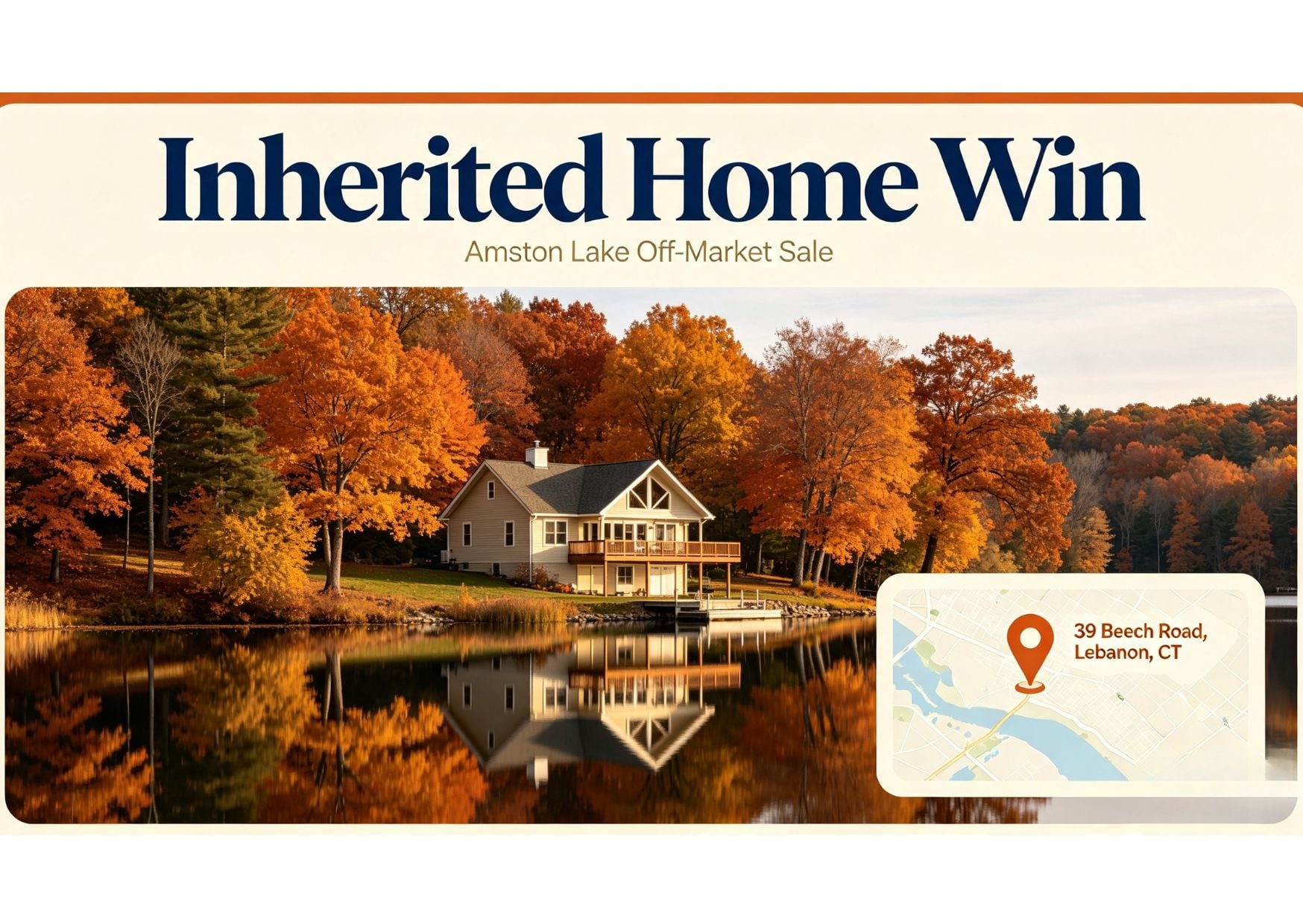
The property at 39 Beech Road in the Amston Lake District of Lebanon had been in the family for years. It was a seasonal home with largely original 1969 finishes, although the heating and cooling system had been updated.
The siblings had reached the point where selling made sense—but agreeing on exactly how and when to sell it wasn't quite as simple.
Some still wanted to use the cottage through the summer.
There were questions about what the property was worth.
There were questions about what should be removed from the house before selling.
And because it was a seasonal property, there was another big question:
What would it take for a future buyer to convert the cottage to year-round use?
Instead of rushing the property onto the market, we worked through those questions.
Ultimately, we found a solution that allowed the family to sell the property for $250,000 without ever publicly listing it for sale.
Even better for the sellers:
We generated two off-market offers, sold the property as-is with no inspection contingency, and negotiated a deal that allowed the siblings to leave behind anything they didn't want to remove.
For this particular family, that simplicity mattered.
TL;DR: 39 Beech Road, Amston Lake
Here's how the sale came together:
Property: 39 Beech Road, Lebanon, CT — Amston Lake District
Built: 1969
Property type: Seasonal lake cottage
Sellers: Four siblings who inherited the property after their parents passed away
Condition: Generally OK, with updated heating and cooling but largely original finishes
Publicly listed: No
Off-market offers: 2
Sale price: $250,000
Condition of sale: As-is
Inspection contingency: None
Cleanout required: No — sellers could leave unwanted contents behind
But the interesting part isn't simply the $250,000 sale price.
It's why selling off market made sense for these particular sellers.
An Inherited Lake Cottage—and Four People Who Had to Agree
Selling an inherited property can be different from a typical home sale.
In this situation, four siblings owned the property together after their parents passed away.
Their parents had originally built the cottage in 1969.
So this wasn't just a piece of real estate.
It was a family property with decades of history attached to it.
And now four different people had to decide what to do.
That's something I encounter with inherited and estate properties: the practical real estate questions can be relatively straightforward, while getting everyone aligned can be harder.
When should we sell?
Should we use it for one more summer?
What should we do with everything inside?
Should we make improvements?
What is it actually worth?
Would putting money into it produce enough additional value to justify the work?
Those questions become more complicated when there isn't one owner making the decisions.
We Started With a Seller Consultation, Not a For Sale Sign
When the family contacted me, we started by discussing their options and what I believed the property was worth.
We talked through timing.
We talked about what preparing the property for sale could involve.
And over the next several months, we stayed in contact as the siblings worked through what they wanted to do.
I didn't think the solution was to pressure them into immediately putting the property on the MLS.
They needed to decide what outcome worked for the family first.
Some family members still wanted to use the cottage through the summer.
There were also disagreements over how much they should remove from the property and what preparing it for a traditional sale would entail.
Meanwhile, I had another idea.
Could We Find a Buyer Before Listing the Cottage?
I had buyers in my network who could potentially be interested in a property like this.
So before going through the entire process of cleaning the property out, preparing it for photography, scheduling showings, and putting it on the open market, I started getting some eyes on it.
That generated interest.
Ultimately:
We received two off-market offers.
That gave the siblings something very different from a hypothetical discussion about what might happen if they listed.
Now we had actual buyers and actual offers to evaluate.
But there was still an important issue to solve.
The Property Was Seasonal. What Would It Take to Make It Year-Round?
This was something I expected buyers to ask.
39 Beech Road was a seasonal property.
And while there are buyers specifically looking for a seasonal cottage, many people purchasing a home around Amston Lake may ultimately want the ability to use it year-round.
Rather than leave prospective buyers guessing about what that conversion might involve, I went directly to the Town of Lebanon Building Department.
I wanted to understand what work would be required to convert the property from seasonal to year-round use.
Once I had that information, I first brought it back to the sellers.
They had a choice.
They could potentially undertake the work themselves before selling.
They decided they didn't want to.
And that was completely reasonable.
They were looking for a simpler sale, not another project.
So instead of hiding the issue or leaving prospective buyers to figure it out on their own, I shared the information I'd gathered with the interested buyers.
That way, they could understand what they were buying and make their own decisions about the property.
Why Solve That Question Before the Sale?
Because unanswered questions create uncertainty.
And uncertainty can kill deals.
If I'm selling an older seasonal cottage and I already know one of the first questions buyers are likely to ask is:
"Can I make this a year-round home, and what would I need to do?"
I'd rather investigate that issue early.
In this case, the sellers didn't want to complete the conversion themselves.
That's fine.
But now the prospective buyers had information they could use when deciding whether the property worked for them.
One of those buyers ultimately did.
The Sellers Didn't Want a Big Project Before Selling
39 Beech Road wasn't a completely renovated modern home.
The heating and cooling system had been updated, but much of the cottage still had its original 1969 finishes.
The family could have spent time and money updating it.
They could have emptied the property.
They could have prepared it for professional photography and public showings.
They could have gone through the traditional listing process.
But that's not what these sellers wanted.
They wanted:
Simple and easy.
And when four siblings are trying to coordinate the sale of an inherited family property, simplicity can have real value.
The Winning Offer Solved More Than Just the Price
We ultimately put together an off-market deal for:
$250,000
But the price was only part of what made the offer attractive.
The sale was:
OFF MARKET
AS-IS
NO INSPECTION CONTINGENCY
And one of the biggest benefits for the family:
They could leave behind anything they didn't want.
That mattered.
The siblings had already disagreed about what needed to be removed and how to handle the contents.
Now they didn't have to solve that problem before closing.
No complete cleanout.
No figuring out who was responsible for removing every remaining item.
No getting the property empty and staged for photographs.
No parade of public showings.
The buyer was willing to purchase the property under terms that solved those problems for them.
Was Selling Off Market the Right Decision?
For these sellers, yes.
But that doesn't mean I'd tell every Amston Lake homeowner to sell off market.
In many situations, I want to expose a property to the entire market.
More exposure can mean:
More showings.
More buyers.
More offers.
More competition.
And competition can produce a higher price and better terms.
If maximizing price above every other consideration is the seller's primary goal, putting the property on the open market may be the strategy I recommend.
But that's not every seller's situation.
Sometimes "Best Offer" Means More Than the Highest Possible Price
There is always a theoretical question with an off-market sale:
Could someone else have paid more if we put the property on the open market?
Maybe.
You can't know with certainty what an entire marketplace would have produced without actually exposing the property to that marketplace.
That's something sellers should understand before deciding to sell privately.
But there's another question that's just as important:
What does the seller actually want the sale to accomplish?
For the owners of 39 Beech Road, they wanted a price they were happy with and a simple solution.
The off-market sale gave them:
Two buyers competing for the property
A $250,000 sale
No inspection contingency
An as-is transaction
No complete cleanout
The ability to leave unwanted belongings
No need to prepare for public showings
A solution to the seasonal-property questions
A transaction the four siblings could ultimately agree on
That's a successful sale.
Why Having Two Off-Market Offers Mattered
There's a big difference between:
"I know someone who will buy your house."
and:
"I have multiple interested buyers and we can compare their offers."
Even though we never publicly listed 39 Beech Road, we were still able to create some competition.
We received two offers.
That gave the sellers options instead of simply handing them one take-it-or-leave-it proposal.
And options matter.
Whether I'm selling publicly or privately, I'd rather have my seller choosing between buyers than depending on one buyer if I can create that opportunity.
Should You Renovate an Older Amston Lake Cottage Before Selling?
Not automatically.
39 Beech Road is a good example.
Much of the property still reflected its original 1969 construction.
Could improvements have changed how some buyers viewed it?
Of course.
But renovations require:
Money.
Time.
Contractors.
Decisions.
And when four siblings jointly own an inherited property, those decisions can become even more complicated.
Before recommending renovations, I'd want to estimate what the improvements are likely to cost and whether the market is likely to reward the sellers enough to justify doing them.
Sometimes the answer is yes.
Sometimes a cleanout and a handful of strategic repairs make sense.
And sometimes the better answer is:
Sell it as-is and let the next owner make it their own.
That's what worked here.
What About Converting a Seasonal Amston Lake Property to Year-Round Use?
This is another situation where I wouldn't make assumptions.
Properties can differ.
Requirements can change.
And what was applicable to 39 Beech Road isn't necessarily the answer for every seasonal cottage around Amston Lake.
If year-round conversion is important to the sale, I want to investigate the specific property and the applicable municipal requirements.
For 39 Beech Road, I met with the Lebanon Building Department to learn what work would be required.
The sellers then had actual information they could use to decide whether they wanted to undertake that work.
They didn't.
So we gave the information to the prospective buyers instead.
That's much better than guessing.
Selling an Inherited Property Is Often About Solving Problems
This transaction is a good example of what I think an agent's job should be.
It wasn't just:
Put the property in MLS → schedule showings → collect commission.
There were several problems to solve.
Problem #1: Four owners weren't completely aligned on timing.
We gave the family time to work through the decision rather than rushing the listing.
Problem #2: They weren't sure how much preparation they wanted to do.
We explored an off-market sale that could eliminate much of it.
Problem #3: The property was seasonal.
I went to the Lebanon Building Department and investigated the year-round conversion requirements.
Problem #4: The sellers didn't want to perform the conversion work.
We disclosed the information to prospective buyers so they could evaluate it themselves.
Problem #5: The family didn't want to completely clean out the property.
We negotiated an offer that allowed them to leave unwanted contents behind.
Problem #6: We still wanted the sellers to have options.
We generated two off-market offers.
Then the family chose the solution that worked for them.
Does Selling Off Market Mean Selling Cheap?
Not necessarily.
But I also don't think sellers should be told that an off-market sale automatically produces the same result as full market exposure.
It might.
It might not.
That's why I think the conversation should start with the seller's priorities.
If you tell me:
"Jason, I want every possible buyer to see my house and I want to maximize competition."
I'm probably going to recommend putting together a strong launch and exposing the property to the full market.
If you tell me:
"We inherited this cottage, there are four of us trying to coordinate everything, we don't want to clean it out, we don't want to renovate it, and we'd consider a strong offer that lets us sell it as-is."
Now an off-market strategy is worth discussing.
39 Beech Road is a perfect example of the second situation.
What If You've Inherited a Property at Amston Lake?
You don't have to know exactly what you want to do before contacting me.
That's actually how this transaction started.
The four siblings weren't completely sure about timing.
They weren't sure how much work they wanted to do.
And they hadn't decided whether selling immediately was even the right move.
We started with a conversation.
Then we worked through:
Value.
Timing.
Condition.
Contents.
Seasonal versus year-round use.
Potential preparation.
Selling publicly versus off market.
Eventually, the right solution became clear.
And it didn't require a For Sale sign.
Thinking About Selling an Amston Lake Home?
If you own a property in the Amston Lake community and are considering selling—whether it's your primary residence, a seasonal cottage, or a property you've inherited—you don't need to decide on the strategy before we talk.
We can first figure out:
What is the property worth?
What should you fix, if anything?
Should you clean it out?
Would converting a seasonal property make financial sense?
Would you likely benefit from full market exposure?
Or do I have buyers who might create an off-market opportunity?
Then you can decide what makes sense for you.
At 39 Beech Road, that process resulted in two off-market offers and a $250,000 as-is sale with no inspection contingency and no complete cleanout required.
For those four siblings, that was the right solution.
Call or text Jason Boice at 860-452-3153 for a no-pressure conversation about your Amston Lake property.
FREQUENTLY ASKED QUESTIONS
Can you sell an Amston Lake property off market?
Yes. An owner can potentially sell without publicly listing the property, provided a suitable buyer can be found. Sellers should understand that an off-market sale doesn't provide the same full-market exposure as a public listing, so the right strategy depends on the seller's priorities.
Can you sell an inherited house in Connecticut as-is?
An inherited property can potentially be sold as-is depending on the transaction and agreed terms. At 39 Beech Road, the four siblings sold the property as-is for $250,000 with no inspection contingency.
Do I have to clean out an inherited property before selling it?
Not always. The handling of remaining contents can be negotiated with a buyer. At 39 Beech Road, the sellers were able to leave behind items they didn't want to remove, eliminating the need for a complete cleanout.
Is it better to sell an inherited property off market or list it?
It depends on the sellers' priorities. Full market exposure may provide greater opportunity to generate competition and maximize price. An off-market transaction can sometimes offer advantages involving timing, convenience, condition, cleanout, showings, or other terms.
Can a seasonal Amston Lake cottage be converted to year-round use?
The answer depends on the specific property and applicable requirements. For 39 Beech Road, Jason met with the Lebanon Building Department to determine what work would be required and provided that information to both the sellers and prospective buyers. Owners should investigate their specific property rather than assuming the requirements are identical.
Should I renovate an older lake cottage before selling it?
Not necessarily. The potential increase in market value should be weighed against renovation cost, time, and inconvenience. For 39 Beech Road, the sellers preferred an as-is transaction rather than completing substantial work before selling.
What happened at 39 Beech Road in Lebanon, CT?
Four siblings inherited the seasonal Amston Lake cottage their parents had built in 1969. After discussing value, timing, preparation, and year-round conversion, Jason generated two off-market offers. The property ultimately sold for $250,000 as-is, with no inspection contingency and with the sellers permitted to leave unwanted contents behind.
Why would a seller choose an off-market offer?
Some sellers value convenience and certainty in addition to price. Avoiding repairs, cleanout, public showings, inspection negotiations, or complicated preparation can make an off-market offer attractive in the right circumstances.
ABOUT THE AUTHOR
Jason Boice is a REALTOR® with eXp Realty serving the Amston Lake community, Lebanon, Hebron, Colchester, Marlborough, Andover, East Hampton, and surrounding Connecticut communities.
Jason helps sellers evaluate both traditional and off-market selling strategies, including inherited and estate properties, seasonal homes, property preparation, pricing, buyer negotiations, and transaction management through closing.
Call or text Jason at 860-452-3153.
Check out this article next